


리디 - 웹툰, 만화, 웹소설, 전자책 모두 여기에!
RIDI Corporation
I came away from 리디 - 웹툰, 만화, 웹소설, 전자책 모두 여기에! thinking of it less as a single-purpose comics reader and more as a broad Korean reading hub. It brings webtoons, comics, web novels, and e-books into one place, which is useful when my reading habits move between formats instead of staying with one type of story. The main appeal is convenience: I can browse visual series, switch to prose, and look for longer-form reading without changing apps.
That breadth is also the reason I would not recommend it automatically to everyone. A focused webtoon service may feel simpler if you only want comics, while a dedicated e-book reader can be a better choice if your priority is a calm, book-first experience. My view is that RIDI works best for readers who enjoy discovering different kinds of Korean content and are willing to spend a little time learning how its catalog and purchasing flow fit together.
What using RIDI feels like in everyday reading
RIDI Corporation has built this app for people who treat stories as an ongoing habit rather than an occasional download. It belongs to the comics category, but that label does not fully describe the experience. The app’s identity comes from the combination of illustrated series, serialized prose, and electronic books. That combination makes it possible to follow a webtoon one day and continue with a novel or e-book when I want a different pace.
In practical terms, I would use it in short sessions as well as longer ones. A few spare minutes are suitable for catching up with a visual episode, while a longer commute or quiet evening makes the prose and e-book side more appealing. The important distinction is that RIDI is not only trying to help me find something to read; it is trying to keep several reading formats close together.
The app is free to install, which makes exploring the service easy. It carries a Teen content rating, so parents and younger readers should treat that label as a reminder to check individual titles rather than assuming every work has the same tone. The developer is RIDI Corporation, and the app has been available since September 20, 2010, giving it a long presence compared with many newer reading platforms.
Related News
Instagram Is No Longer a Photo App. It Is an Attention Engine

Microsoft Teams Mobile: When Collaboration Becomes Navigation

How the NFL App Adapts to Android and iOS Updates

Temu: Elevate Your Shopping Experience to Billionaire Status

Why Traffic Rider Works Best as a Precision Reflex Game

How Google’s Find Hub Transforms Everyday Searches
Its current version is 26.1.1 and it requires an operating system version 9 or later. That requirement is relatively approachable for users with older compatible devices, although the actual reading comfort will still depend on screen size, display quality, and how well the phone handles a content-heavy app. I would check compatibility before planning to use it on an older tablet or secondary phone.
A strong case for one app covering several formats
The clearest strength is the way the different formats support different moods. Webtoons are immediate and visual, comics offer another illustrated reading style, web novels can make a story feel more continuous, and e-books suit readers who want a more conventional book session. I like that this variety can reduce the temptation to install several separate services simply because my interests change during the week.
There is also a useful discovery advantage. When I finish a visual series and still want something with a similar storytelling rhythm, staying inside the same reading environment makes the next choice feel less disruptive. The transition is not guaranteed to be perfect, because catalog organization and title availability matter, but the overall concept is more flexible than a narrowly focused comics app.
Gallery
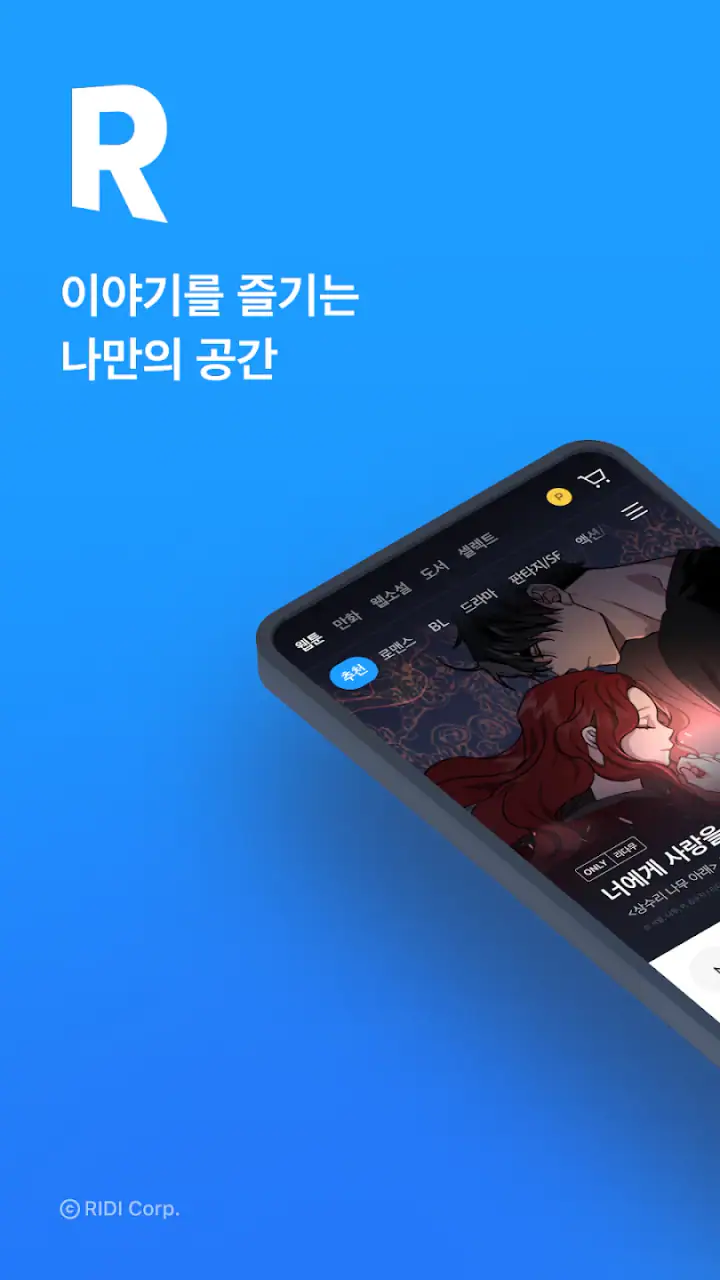
RIDI’s public response suggests that many readers find this model worthwhile: it holds an average rating of 4.3 from around 38 thousand ratings and has passed 5 million installs. I would not treat those figures as proof that every part of the app will suit me, but they do indicate that the service has reached a substantial audience and maintained enough appeal to attract repeated attention.
One detail worth understanding before spending time browsing is that the app is free while offering in-app purchases ranging from $0.99 to $189.99 per item. That wide range means I would approach the catalog with a budget in mind. Free installation is helpful for testing the reading experience, but it should not be confused with unlimited access to every story or book.
How I would organize a realistic reading routine
Imagine that I have a busy weekday. During a short break, I might read part of a webtoon because the visual format is easy to pick up and put down. Later, when I have more uninterrupted time, I could switch to a web novel or e-book instead of opening another service. This is where the app feels more practical than a collection of separate readers: the change in format follows my schedule, not the limits of the software.
My first useful tip would be to decide what kind of session I am starting before browsing deeply. If I want a quick visual read, I would begin in the comic-oriented areas rather than wandering through the entire catalog. If I am looking for a longer commitment, I would first narrow my search to prose or e-books. This small habit prevents the variety from becoming distracting.
A second tip is to treat purchases as part of a reading plan. Since individual items can cost very different amounts, I would avoid buying impulsively after discovering a promising title. I would first read enough of the available preview or opening material to decide whether the writing, artwork, and pacing suit me, then consider whether I am ready to continue. This is especially important for serialized works, where liking the premise does not always mean I will enjoy the long-term rhythm.
A third insight is that format switching can change how I judge a story. A webtoon may deliver its impact through panel composition and visual timing, while a web novel depends more heavily on prose flow and imagination. When I move between them, I try not to compare them by the same standard. RIDI is strongest when I use each format for what it does well, rather than expecting every title to provide the same kind of reading satisfaction.
The friction behind the broad catalog
The same range that makes RIDI attractive can make it feel less focused. Someone arriving with one simple goal may have to make more decisions than expected: which format to choose, whether a title is a good fit, and how much of the reading journey may involve purchases. I find that manageable, but readers who want an extremely direct “open the app and read” experience may prefer a service built around one medium.
There is also a mental cost to having so many possible reading directions. Discovery can turn into browsing without reading, especially when I open the app without a clear idea of what I want. I would not call this a flaw unique to RIDI, but the mixture of comics, webtoons, novels, and e-books makes it more noticeable than in a specialized reader.
The purchase structure deserves careful attention as well. The free app is a good way to inspect the interface and understand the catalog, but the presence of item-based purchases means the total cost depends on my choices. A reader who prefers a predictable subscription or a large library covered by one fixed payment may find RIDI less comfortable as a primary reading service.
Another limitation is audience fit. The Teen rating makes the service unsuitable as an automatically unrestricted children’s reading space. Families should select titles thoughtfully, and readers who need strictly filtered material may want a platform with a narrower editorial focus. I also would not choose it solely for English-language reading unless I had already confirmed that the specific titles I wanted were available in a language I could comfortably read.
Where it compares well with familiar alternatives
Compared with a dedicated webtoon app, RIDI’s advantage is range. A specialist may offer a cleaner experience for someone who only wants vertically scrolling illustrated episodes, but RIDI gives me more room to change direction. That matters if my interest in comics is tied to a wider interest in serialized storytelling rather than to one visual format.
Compared with a general e-book reader, RIDI feels more connected to contemporary serialized entertainment. The presence of webtoons and web novels gives the service a different energy from a quiet library-style reader. The trade-off is that the interface and catalog may feel busier to someone who wants books to be the unquestioned center of attention.
Compared with using separate apps for comics, novels, and books, RIDI is more convenient when I value one account and one reading destination. The compromise is that no single section may feel as deeply specialized as the best standalone alternative. My choice would depend on whether convenience across formats matters more to me than having the most refined experience for one format.
This is why I see RIDI as a complement as much as a replacement. A dedicated reader may still be better for someone who reads long e-books every day, and a focused comics service may be better for a reader who cares about rapid visual browsing above everything else. RIDI earns its place when variety is part of the goal.
Who will get the most from the app
I would recommend it to readers who already enjoy Korean webtoons or web novels and want a broader home for that interest. It is particularly appealing to people whose reading time changes from day to day: short sessions for illustrated stories, longer sessions for prose, and occasional e-book reading when they want something more substantial.
It can also suit curious readers who like following a story across formats or exploring beyond the title that first brought them in. The key is patience. I would spend a little time learning where each format lives and how purchasing works instead of judging the whole app after a quick glance.
I would be more cautious about recommending it to a reader who wants only free content, dislikes item-based purchasing, or expects one fixed subscription to cover everything. I would also suggest another option for someone seeking a minimalist book reader, a tightly controlled children’s catalog, or a service designed primarily for one language and one content type.
For a new user, my practical starting routine would be simple: install the free app, check device compatibility, browse one section at a time, and choose a small number of titles rather than trying to understand the entire catalog immediately. Pay attention to the Teen rating when selecting stories, and set a spending limit before making purchases. Those steps make the first experience calmer and reduce the chance of confusing discovery with commitment.
My verdict after weighing convenience against control
RIDI succeeds because it understands that many readers do not stay inside one format. Its combination of webtoons, comics, web novels, and e-books gives me a flexible way to match reading material to my mood and available time. The free entry point helps with exploration, while the established presence of the service and its sizable user base make it feel like a serious reading platform rather than a temporary experiment.
My reservation is that breadth brings responsibility to the reader. I need to manage my browsing, pay attention to the cost of individual items, and choose titles with the Teen rating in mind. The app is not the best answer for every reading style, and its variety can feel like clutter if I want a single-purpose tool.
Overall, I would recommend 리디 - 웹툰, 만화, 웹소설, 전자책 모두 여기에! to anyone who wants Korean story content in several forms and values convenience over a perfectly specialized interface. I would skip it in favor of a focused alternative if my needs are limited to one medium, a fixed-cost library, or a highly minimal reading environment. For the right reader, though, its strongest feature is not any one category; it is the freedom to move between them without treating each change in mood as a reason to start over.
FAQs for 리디 - 웹툰, 만화, 웹소설, 전자책 모두 여기에!
What is 리디 and what content can I find on it?
리디 is a comprehensive digital platform offering a wide range of content, including webtoons, comics, web novels, and e-books. Users can explore various genres and discover new stories or continue with their favorite series. It's a one-stop destination for digital reading enthusiasts on both Android and iOS devices.
Is there a subscription model available on 리디?
Yes, 리디 offers both free and premium content. Users can opt for a subscription model to access premium content without any limitations. This model often provides additional benefits, such as ad-free reading and early access to new releases, enhancing the overall user experience.
How user-friendly is the 리디 app for new users?
The 리디 app is designed with user-friendliness in mind, featuring an intuitive interface that makes navigation easy for users of all ages. Whether you're browsing new titles or managing your library, the app ensures a seamless experience with efficient search functions and personalized recommendations.
Does 리디 support offline reading?
Yes, 리디 supports offline reading, allowing users to download their favorite webtoons, novels, and books to enjoy without an internet connection. This feature is particularly useful for users who want to read on the go, ensuring they have access to their content anytime, anywhere.
What are the device requirements for installing 리디?
리디 is compatible with both Android and iOS devices. For Android, it typically requires version 5.0 or higher, while iOS devices need iOS 11.0 or later. It's recommended to have a stable internet connection for downloading and syncing content, though offline reading is available once content is downloaded.
Pros
- Wide variety of content available.
- User-friendly interface design.
- Offline reading mode.
- Regular content updates.
- High-quality illustrations.
Cons
- Requires internet for some features.
- Limited free content access.
- Ads in free version can be intrusive.
- Some titles only in Korean.
- Occasional app performance lag.


